Asset Allocation: Why Select This Mix Of ETFs?

Seeking Alpha


Gauss is the newest portfolio launched (12/27/2011) here. While the annualized performance is a respectable 25%, it still lags both the VTSMX and ITA Index benchmarks as it took time to populate all 15 equity and bond asset classes. The broad market was in a positive mood during the launch phase and as a result, the portfolio fell behind the benchmarks.
Instead of looking to the past, what are the forward projections for the Gauss based on Quantext Portfolio Planner (QPP) analysis? To answer this question, I stretched out the analysis period to 53 months so as to include all of the last bear market and to make sure every ETF had complete historical data. Moving out to 60 months would have corrupted the analysis as a few ETFs do not have five-year histories.
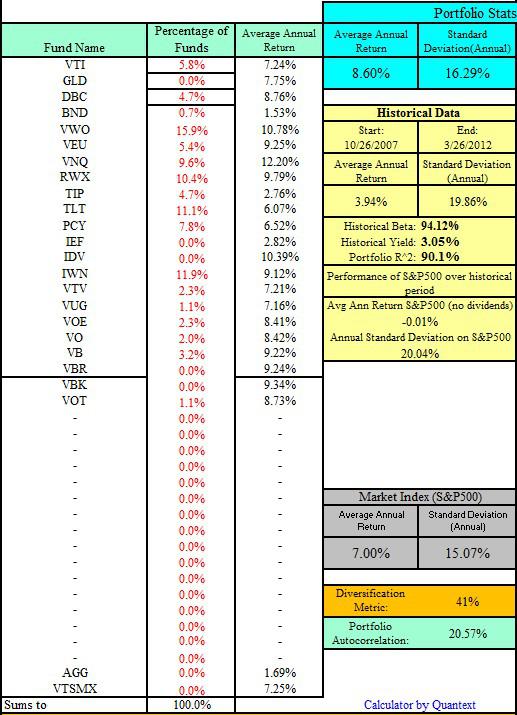
QPP Analysis: In the following screen shot, the current ETFs and the percentage they occupy in the portfolio are listed below. The percentages were updated this morning just after the market opened.Platinum readers will recall there are goals set for the Strategic Asset Allocation plans for each portfolio.
  1. The projected annual return is to exceed the projection for the S&P 500 by one percentage point. This portfolio is projected to best the S&P 500 by 1.6% points.
  2. The projected standard deviation should come in under 15%. The Gauss does not meet this standard. However, the Gauss is one of the ITA Risk Reduction candidates and we plan to hold down portfolio uncertainty by using the ITARR model. For this reason, we are less concerned about the 16.3% SD projection.
  3. The Diversification Metric is to exceed 40%. The Gauss meets this goal.
  4. The desired Portfolio Autocorrelation will be something below 20%. The Gauss is close. This metric is the least important of the four.
There are several ETFs included in the list where we do not currently hold any shares. Those ETFs are held for historical purposes or are place holders for possible investments in the future.
Click to enlarge
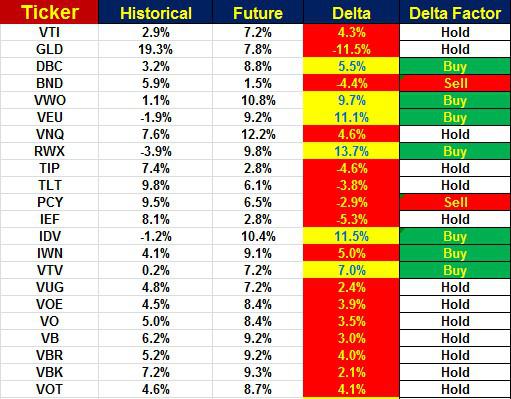
Delta Factor Projections: In the data table below, we find the "Delta Factor" projections based on 53 months of historical data. The reference for bond and treasury ETFs is AGG while the benchmark for the equity oriented ETFs is Vanguard's VTSMX.
Even with the current market as high as it is, there are still some opportunities for investment. VWO is one and I added a few shares of emerging markets to the Gauss over the last month. VEU is another commission free ETF that merits attention. As readers will see, the Gauss is invested in all the important asset classes as all the individual ETFs are priced above the current 195-Day Exponential Moving Average.

Three Candidates for Shorts: SPRD - SODA - WLT

Yesterday, Wall Street pull back for fifth in seven days. On Wednesday the drop was slightly more pronounced. In fact, until the two p.m. seemed it would be a very bad day. But from that hour there was a certain reaction. However, yesterday's drop was quite large, both in industry and individual stocks.

This pull back is not even very serious. The three major indices closed above the SMA18 days and the major technical indicators mostrron not much damage. Again, the volume was kept at a low level and the slightly increased volatility.

Given this situation, our system detected a good number of stocks that showedsignificant drops and become in potential shorts. Below we present three of these stocks.


Spreadtrum Communications Ads. (SPRD).- Price: US$ 15.65 (Var: -6.65%). Volume: 1.01 Millions of shares (daily moving average: 1.25 M). Start a new leg down. Next stop around US$ 14.20.
SodaStream International Ltd. (SODA).- Price: US$ 32.20 (Var: -5.60%). Volume: 1.73 Millions of shares (daily moving average: 1.79 M). New low but is oversold. Next support level at US$ 29.82.
Walter Energy Inc. (WLT).- Price: US$ 57.83 (Var: -5.27%). Volume: 3.51 Millions of shares (daily moving average: 2.57 M). Good fall with high volume. Its ready to go to new low. 


Free Down Trend Stock Picks includes three stocks that have experienced daytime significant price falls. These stocks have been selected from a list includes stocks that have shown the worst performance of the last 52 weeks.This means these are stocks with a medium-term downward trend.

Three Candidates for Longs: AMLN - GCA - BVSN

Yesterday the market fell again. This time in a more pronounced. However, still can not speak of the danger of a correction. The three major indices closed above the level ofSMA 18 days and the major technical indicators we work with do not show muchdamage. Will have to wait one or two more days before giving a more forceful.Our system found a small number of stocks that experienced good gains. Below we present  three of these stocks.


Amylin Pharmaceuticals Inc. (AMLN).- Price: US$ 23.77 (Var: +54.45%). Volume: 43.29 Millions of shares (daily moving average: 2.98 M). New high with huge volume.
Global cash Access Holdings Inc. (GCA).- Price: US$ 7.54 (Var: +7.71%). Volume: 2.20 Millions of shares (daily moving average: 0.73 M). Another New high with good volume.
BroadVision Inc. (BVSN).- Price: US$ 29.66 (Var: +7.08%). Volume: 0.66 Millions of shares (daily moving average: 0.60 M). Its only a one day reversal. 


Free Up Trend Stock Picks includes three stocks that have experienced daytime significant price Hikes. These stocks have been selected from a list includes stocks that have shown the best performance of the last 26 weeks.This means these are stocks with a medium-term upward trend.

Still Awhile Before Retirement? Save, Save, Save!

By 


Expert Author Lon Jefferies
One of my clients recently took advantage of my offer to sit down with and advise his daughter. This young woman was 25 years of age and just getting started with her career. Along with eliminating consumer debt, it was clear that the most helpful advice I could provide was to save early and save often.
Since the status of Social Security when this young lady retires in more than 40 years is uncertain, my advice was to take control of her own retirement planning. Of course, any benefit that Social Security provides will be a welcome supplement, but it may be wise for young individuals to take full responsibility for ensuring their retirement income needs are met.
To illustrate the importance of saving, I asked this woman how much money she currently spends each month. After including rent, a car payment, and all other expenses, we found that she needed about $3,000 per month - or $36,000 per year - to cover her costs. First and foremost, we calculated the impact of inflation on her retirement planning. Assuming a 3% annual inflation rate (which has been about average over the last 100 years) we determined that in 40 years, when she is 65 years old, she will need $9,786 per month - or $117,433 per year - to maintain her current standard of living. As you might expect, the impact of inflation alone was enough to catch this individual's attention.
We then discussed how long she expects to live. Of course, we agreed that running out of money was the last thing she wanted to happen, so she wanted to ensure she has enough funds to support her through 30 years of retirement, from age 65 to 95. Keeping in mind that we wanted to be confident that her funds would last, we assumed she would have a relatively conservative portfolio during retirement and selected a nominal (pre-inflation) 6% rate of return on her investments. Given a nominal 6% return and an inflation rate of 3%, we calculated that the real (inflation-adjusted) rate of return on her investments would be 2.91% (calculated as such: (1.06/1.03) - 1)). Thus, if she wanted to have the ability to spend an inflation-adjusted $117,433 per year between ages 65 to 95, and her investments were earning a real return of 2.91% over this time period, she would need to have $2,328,748 saved when reaching age 65. Again, as you can imagine, this figure raised some eyebrows as well.
Finally, we asked what this woman needs to do over the next 40 years to establish a nest egg of $2,328,748 by the time she retires. As this individual can afford to take a little more risk with her portfolio because she has 40 years until retiring, we assumed her portfolio could obtain a nominal rate of return of 8% during the accumulation phase. Still, even assuming an 8% return and knowing she has 40 years to save, we calculated that this woman would need to save $8,989 each and every year in order to develop the nest egg she sought after.
Naturally, the young lady was concerned about this rather large savings figure that would be required in order to enjoy what seemed like a relatively basic standard of living during retirement. I used this opportunity to illustrate the importance of taking advantage of any employer match provided on her company retirement plan. Of course, if an employer provides a 100% match on employee contributions to a 401k plan, this could cut the amount of savings required by the young woman by as much as half. I also reminded the individual that people's ability to save commonly increases as their career progresses because earnings tend to increase while consumer debt and student loans tend to decrease.
However, it was vital that the young woman understood the importance of beginning to save as early as possible. To illustrate this point, we preformed the same calculation assuming she waited 10 years, or until she was 35, to begin saving. To have the same accumulated nest egg of $2,328,748 at age 65 but waiting 10 years to begin saving, she would need to invest $20,556 each and every year between 35 and 65. Conversely, if she had started to save five years early at age 20, she would only need to save $6,025 per year. Clearly, every lost year increases the amount of necessary savings dramatically.
In reality, very few 25-year-olds can contribute $8,989 per year to retirement accounts. However, the lesson is to save early and save often, and that taking full advantage of any employer match offered within an employer's retirement plan goes a long way. Any small amount contributed early drastically reduces the retirement saving burden later in one's career.
Finally, meeting with my client's children to provide a similar lesson is a service I enjoy providing. Check with your financial professional and take advantage of his offer to communicate the importance of saving to your loved ones.
Lon Jefferies is an investment advisor representative with Net Worth Advisory Group, a fee-only financial planning and investment advisory firm in Salt Lake City, Utah. He specializes in developing custom financial plans, implementing investment strategies, and providing ongoing support and service in order to help clients reach their financial goals. He can be contacted at             (801) 566-0740 begin_of_the_skype_highlighting            (801) 566-0740      end_of_the_skype_highlighting       or lon@networthadvice.com. Visit the Net Worth Advisory Group website at http://networthadvice.com and read Lon's blog at http://www.utahfinancialadvisor.blogspot.com.